
Reliability isn’t a specification. It’s the whole product.
Ask anyone in drinks dispense what a good day looks like and you’ll get the same answer, phrased fifty different ways: nobody noticed the equipment.
No queue at the bar. No warm pour. No engineer call-out at nine o’clock on a Saturday. No manager staring at a cooler that’s given up halfway through a cup final. The dispense system did its job quietly, at pace, for hours, and then did it again the next day.
That is a deceptively hard thing to engineer, and it is the single idea that everything we do at Stanwell Technic is built around.
We work with some of the largest breweries and soft drinks producers in the world. That relationship sets the standard for everything that leaves our door, because those brands don’t get to have an average night. Their product has to pour perfectly in a quiet country pub on a Tuesday and in a 60,000-seat stadium at half time — same quality, same temperature, same brand experience.
So when we assess whether a piece of dispense equipment is ready for market, we don’t ask whether it works. We ask whether it works on the worst possible day: peak trade, full ambient heat, back-to-back service, an untrained seasonal team, and a queue that isn’t getting any shorter.
Average-load performance is easy to design for. Peak-load performance is where dispense equipment either earns its place or quietly costs an operator thousands in lost serves.
Remanufactured Compressors, Backed by a Five-Year Warranty
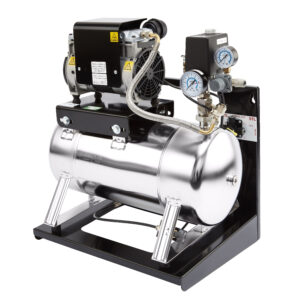
Our compressor servicing and refurbishment programme is built to a different test: the unit has to perform as new, or it doesn’t ship. That means stripping back to component level, replacing wear parts rather than assessing them optimistically, and testing to the same performance criteria we would apply to a factory-fresh unit.
We back it with a five-year as-new warranty, because a warranty is the only honest way to put your money where your engineering is. If we are asking an operator to trust a remanufactured compressor through five summers, the commercial risk should sit with us, not with them.
The sustainability case makes itself. Remanufacturing keeps serviceable equipment out of the waste stream and significantly reduces the embodied carbon of a replacement unit compared with new manufacture. But it only counts as a sustainability win if the equipment lasts. Circular economy thinking that results in a second failure two years later isn’t circular, it is simply delayed waste. Longevity is the environmental strategy.
Fast Dispense for Stadia, Festivals and High-Volume Venues

Event and stadium dispense is the most unforgiving environment in hospitality. Demand doesn’t build gradually, it arrives in a wall at the whistle and disappears twenty minutes later. Every serve you can’t deliver in that window is revenue you never recover.
High-speed dispense exists to attack exactly that constraint: pours per minute, consistent quality at speed, and equipment that holds temperature and carbonation under sustained heavy draw rather than degrading after the first hundred serves. Event bars and mobile kiosks face the same problem with the added challenge of temporary infrastructure.
The commercial maths is straightforward. Cutting seconds per serve at a venue turning over tens of thousands of drinks in an afternoon doesn’t just improve throughput. It changes how many bars a venue needs, how many staff those bars need, and how long a customer is willing to queue rather than give up and return to their seat. Speed of service is a revenue lever, not a convenience.
New Categories: Coffee, Cocktails and Water
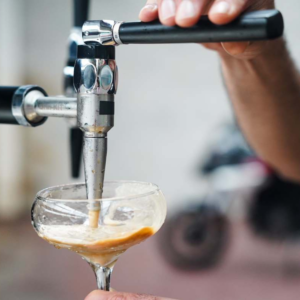 The definition of dispense is widening quickly, pushed by consumer behaviour rather than by equipment manufacturers.
Coffee dispense is now a genuine day-part strategy for operators who used to write off their mornings entirely. Cocktail dispense has moved from specialist bars into volume venues, where the challenge is consistency and speed: delivering a properly made drink without a trained mixologist and ninety seconds of build time per serve. Water — still, sparkling, chilled, filtered on site — is the quiet growth story, driven by the collapse in single-use plastic tolerance and by operators recognising that bottled water is a logistics cost they can design out.
Each category brings its own engineering problems. But all are subject to the same test we apply to beer and soft drinks: can it hold up at volume, on the busiest day, for years? A cocktail system that produces a beautiful drink and falls over on a Friday night hasn’t solved anything.
Why Every Millilitre Counts
Hospitality is absorbing cost pressures it has never faced simultaneously before: energy, labour, ingredients, property and compliance. In that environment, the tolerance for waste has effectively hit zero.
That reframes what dispense equipment is for. It is no longer just a delivery mechanism, it is a yield-control system. Product disappears in four main places: line waste at cleaning, changeover and cellar management; foaming and over-pour, particularly with untrained or seasonal staff; temperature failure, which turns a perfectly good keg into a pour nobody accepts; and downtime, the most expensive waste of all, because those serves never happened.
Improve yield by a few percent across a multi-site estate and you have added margin without adding a single customer. That is why automation, monitoring and consistency-by-design have moved from nice-to-have to central. Automation is not about removing people from hospitality. It is about removing variance, so that a good result doesn’t depend on who happens to be on shift.
Every drop, every millilitre, has a cost attached to it now. Equipment that respects that is equipment that pays for itself.
What Comes Next
We are using this space to do two things. Some posts will go deep on the technical and the specific: what actually happens inside a remanufactured compressor, how we test for peak-load performance, what changes when you dispense coffee or cocktails instead of lager, and how operators can measure and reduce dispense waste across an estate.
Others will step back and look at where hospitality is heading — sustainability, automation, changing consumer habits, and the pressures reshaping how drinks get from cellar to customer.
Different subjects, one throughline: solutions that are reliable and that work at scale, when it matters most.
Planning for a venue, an estate or an event where the busiest hour decides the day? Stanwell Technic provides engineered dispense solutions built to deliver consistency, reliability and performance at volume. sales@stanwelltechnic.co.uk